Sunday, November 2, 2008

A Debut of Distinction

Saleema Nawaz's Mother Superior is favorably reviewed. It includes short stories and a novella.

"But the subjects coalesce in the highly readable and involving novella, 'The Republic of Rose Island.' Here the woman narrator, named Georgia, tells the story of her late father, a rare stamp dealer, and her sister Lisa, who has disappeared somewhere in Europe.

Before leaving, Lisa was having an affair with handsome, rich Will, and is now pregnant. Will helps Georgia try to find Lisa, but slowly Georgia realizes that Will may not be as benign as he appears. Part mystery, part love story, it gains momentum without ever quite reaching its destination – which, in this case, more than satisfies."

A Slim Selection

A reflective review from The Hindu on a few classic selections.

"There are times when the mind hesitates to enter a substantial book, aware that it will not be able to do justice. [...] I look for the slimmest volumes, nothing more than a hundred or so pages, nothing that cannot be finished in one sitting. Surprisingly, there are many and the pile soon builds up. [...] So sometimes, four slim books can add up to more than four slim books. Or perhaps there are times when things simply resonate more."

Saturday, November 1, 2008

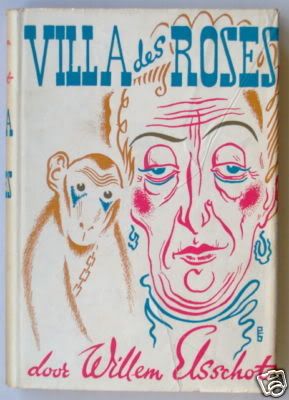
Villa des Roses

On my bookshelves, I have the entirety of Willem Elsschot's novellas translated into English. This impressive collection amasses three volumes: Cheese, Three Novels (a novella anthology containing Soft Soap, The Leg, and Will-'O-The-Wisp), and Villa des Roses. Had I more Flemish or Dutch litterateurs visiting my study, they would surely be impressed.

Villa des Roses is a character-driven novella with an episodic plot. To be accurate, it is populated by at least thirteen characters -- I may have miscounted, for it could be more -- and most of the episodes take place within the Villa des Roses, a pension in Paris. One of the major characters, Louise, is introduced in the shortest chapter of the novella: fifty-six words and then in the very next chapter she is hit on by all the men at the Villa des Roses. Eventually, she will fall in love with Richard Grünewald. This affair is effectively and sympathetically realized.

Madame Brulot, the Madame of Villa des Roses, appears in almost of every chapter. Like the pension itself, she acts as a gravitational force for the action in the novella, for all the happens is noted and noticed by her. She is married and owns a pet monkey, who will be murdered in an alternatively horrific and darkly comic episode. The murderer, Madame Gendron, the decrepit resident kleptomaniac who is brilliantly featured in a chapter entitled "The Oranges," will manage her revenge without getting caught. And the reaction of Madame Brulot, in just one or two phrases, shifts the horrific episode into a comic banality.

There are various ideas about novellas only consisting of one central character in a limited time frame and within a limited action. In its character density (there are more characters per square inch in this novella than in any other I can recall), Villa des Roses shows that theories are quaint distractions that no author nor reader should heed.

While reading Villa des Roses, I couldn't help but think of the British comedy, Fawlty Towers. This novella has a sitcom atmosphere similar to that classic Britcom, yet it lacks the histrionically loud John Cleese. Most of the humor in Villa des Roses is deadpan and subtle. Elsschot is essentially a realist with a wicked and whispering sense of humor.

What's a director to do with a novella that reads thicker than its spine? The smart money would tell you to focus on a few characters in order to focus the narrative arc, even though other characters may minimized or left on the cutting room floor. By training the camera on Louise and Robert's tragic romance, the film version of Villa des Roses achieves a certain focus that novella may have lacked, but it ultimately suffers in substance and depth. Certain episodes seem out of place when interspersed with the love story. Madame Gendron's orange stealing scene feels unmoored and isn't funny, and her later revenge killing of Chico doesn't really make sense.

Director Frank Van Passel does an admirable with the melancholic atmosphere of the novella. In the film's centerpiece, we see the tragedy of abortion and how it effects Robert and Louisa as well as other residents of the Villa des Roses. Were the entire film handled as well as this harrowing episode, it would have been a superb film.

Unfortunately, most of the subtle elements of Ellschot's comedy of manners are lost in this adaptation. Some of the initial scenes of Robert and Louise falling in love are touching and show the tension and uncertainty during the first blush of new love. On the whole, the comic dimension is muted and ineffective. Not too say that Elsschot's novella is a laugh riot, but its humor, whether dark or sardonic or witty, is always under the surface of each scene. The film's ending is trite and to a certain degree predicable -- rather unlike the novella's.

The film is heavy in the appropriate moments and these are its strongest scenes. But it fails when dealing with the novella's elegant, sardonic touch and its rich assortment of characters and their interaction with each other in the Villa des Roses. Julie Delpy's portrayal of Louise is wonderful and her onscreen relationship and interaction with Shaun Dingwall as Richard Grünewald is nuanced and believable. Shirley Henderson's Ella, the cook, acts as our tour guide and is a good foil for Delpy. Though Aasgaard is a minor character in both the novella and the film, Erik Vercruyssen does an admirable of making him memorable and reminds a reader of the novella that its minor characters add depth and texture.

It is one thing to say that the book is better than the film, which in the case is certainly true. By extension, the film has given me a greater appreciation of the novella and Elsschot's deft style. When I first finished reading the novella, I wasn't sure if I wanted to return to it again. After seeing the film, I know that I must book a return visit to Villa des Roses.

Alembical from Golem Press

A new anthology released today! From the website ...

"Our second book, "unofficially" releasing at the World Fantasy Convention 2008 on November 1st, is Alembical, an anthology that extends Paper Golem's commitment to the genre by focusing on the novella, an all too often, under-appreciated length. Alembical gives voice to four of the field's most dynamic writers at the powerful novella length, leaping from sub-genre to sub-genre, and leaving the reader breathless in the process. This anthology will redefine your understanding of the novella."

Redefine my understanding of the novella? Sounds exciting! This is the first volume in an annual anthology featuring four authors: Jay Lake, Bruce Taylor, James Van Pelt, and Ray Vukcevich.


Friday, October 31, 2008

The Man In The Picture: A Ghost Story by Susan Hill


A truly chilling tale, The Man In The Picture haunted me as I read it. A story within a story and yet within another story -- quite apropos, frame story for a story about painting -- the overall tale is about a painting of a Venetian carnival and the characters within it, one of whom makes eye contact with viewers. As we get deeper into the scene and eventually deeper into the dark history of the painting and its subjects, we become drawn into a dark world of dread.

The telling of such a tale is supposed to relieve the teller of the secret burden of such supernatural occurrences. Yet when a tale is passed on, the hearer bears the burden and can become consumed with the horrific, inexplicable details. One knows that the tale is true, but also knows that it must not be true. For were it true, the truth would be too terrifying. Paintings are not supposed to change, especially after the oil has been dry for decades. The old saw tells us that life imitates art. The Man In The Picture explores that notion and scares us with its implications of mortifying mimesis.

Wednesday, October 29, 2008

Here's a toast to 'Tiffany's' on landmark novel's 50th birthday

One of the books on my Lit Flicks Challenge list!


Myra Overton has sailed here from England on the Queen Mary 2 to celebrate her 70th birthday. First stop: Tiffany & Co. on Fifth Avenue.

In her purse is an envelope addressed to "Mum." Inside is a homemade card sporting a photocopy of the iconic image of Audrey Hepburn with her long cigarette holder.

"You really can have breakfast at Tiffany's," reads the note from her son and daughter-in-law. It also says a gift card is waiting for her on the third floor.

"An American on the ship told me to forget about the movie and read the book," says Overton, who is from York, England. "He said it was the best thing Capote ever wrote. So I'm going out and finding it after I go in here."

That's impeccable timing on her part, because it's the 50th anniversary of Truman Capote's Breakfast at Tiffany's. A special edition (Vintage, $12.95, paperback) of the novella is being released in November, packaged with three other Capote classics, including A Christmas Memory.


Link.

Monday, October 27, 2008

Bookslut October Roundup

In the past Bookslut had a novella review series, Small, But Perfectly Formed. While that series no longer runs, they still frequently review novellas. Each month I'll offer a roundup of their offerings.

A History of the World for Rebels and Somnambulists by Jesus del Campo

"Enter the Spanish philologist Jesus del Campo and his slim, crazy, funny, History of the World for Rebels and Somnambulists, which is exactly what it says it is. It’s a roughly -- very roughly -- chronological account of world history, marked by the bravado and befuddlement of presidents, biblical figures, scientists, poets, magicians and God alike."

The Bruise by Magdalena Zurawski

"Had I not completed Magdalena Zurawski’s prize-winning novel, The Bruise, with my fingers gripping the cover and its pages pressed beneath my thumbs, I might have questioned whether my astonishing literary odyssey was instead some feverish dream."


Hail The Three Marys, a review of three novellas by Marie Darrieussecq, Marie-Claire Blais, and Marie Ndiaye.

"A trio of Maries, writing in their French mother tongue, have emerged on the literary scene, and have proved that they can break out of the gender mould, whilst remaining defiantly feminine. These talented women have relaunched the French novel on the international stage, and are forcing the critics to retract their draconian judgments."