Monday, November 15, 2010

Crimes Against Brevity
Robert McCrum notices that the trend for longer books, fiction and non-fiction, goes against the contemporary desire for brevity in TV, film, and so forth. He offers up his own list to counteract the long-winded tomes. A few of these I have yet to read.
1. George Orwell: Animal Farm
2. Jean Rhys: Wide Sargasso Sea
3. Evelyn Waugh: The Loved One
4. Henry James: The Turn of the Screw
5. RL Stevenson: Treasure Island
6. Joseph Conrad: Heart of Darkness
7. Marguerite Duras: The Lover
8. F Scott Fitzgerald: The Great Gatsby
9. Graham Greene: The End of the Affair
10. Muriel Spark: The Prime of Miss Jean Brodie
Thursday, October 8, 2009
And I'm back after a spell ...
The Dog Barks' Anton Ego plugs this blog and reviews the novella Nobody Moves by Denis Johnson. Though readers of BBBE may wonder whether or not the book is indeed a novella, we should be charitable towards Mr. Ego's first foray into novella criticism.
"I love Chandler and Hammett, from whom this book certainly descended, and I love British gangster flicks like Snatch and Lock, Stock and Two Smoking Barrels. But unlike its cinematic counterparts, Johnson's shoot-em-up is rather bland. It's not as black, as noir, as sleak, as other reviewers have reported. Perhaps Johnson is making some ironic statement about formulaic fiction. Or maybe he was just having fun."
The rest of the review is witty and wicked.

"I love Chandler and Hammett, from whom this book certainly descended, and I love British gangster flicks like Snatch and Lock, Stock and Two Smoking Barrels. But unlike its cinematic counterparts, Johnson's shoot-em-up is rather bland. It's not as black, as noir, as sleak, as other reviewers have reported. Perhaps Johnson is making some ironic statement about formulaic fiction. Or maybe he was just having fun."
The rest of the review is witty and wicked.

Sunday, December 14, 2008
Tryst and Shoot
The NYTimes reviews Jean-Phillipe Toussaint's Camera.
"That 'Camera' should have waited 20 years to find an English-language publisher is scandalous. That the wonderful Dalkey Archive has taken on the task is unsurprising. While Toussaint’s long, chatty sentences sometimes trick the translator Matthew B. Smith into losing his syntactical thread, this version admirably renders the frankness that makes Toussaint so alluring."
It is refreshing to read a review of a novella that doesn't mention "novella" or any of the other slim gem words.
"That 'Camera' should have waited 20 years to find an English-language publisher is scandalous. That the wonderful Dalkey Archive has taken on the task is unsurprising. While Toussaint’s long, chatty sentences sometimes trick the translator Matthew B. Smith into losing his syntactical thread, this version admirably renders the frankness that makes Toussaint so alluring."
It is refreshing to read a review of a novella that doesn't mention "novella" or any of the other slim gem words.
Friday, November 21, 2008
Silk
 In what ways can unrequited love occur? The classic tale requires that one falls for another who cannot return the love, and its variations are manifold. Alessandro Baricco's Silk imagines unrequited love happening between the last two people on earth that we'd expect.
Hervé Joncour travels from his village in France to Japan once a year to purchase the silkworm eggs necessary for his village's industry. While in Japan, he falls for his contact's concubine, the only woman in Japan without oriental eyes. He never speaks to her, but she does give him a short letter. He returns to Japan several times, partly on business but mainly to see this woman again. Eventually, war intervenes and his trips must end but he receives a final letter written in Japanese that will unravel his life.
Each chapter is meticulously brief. Baricco's prose is as light and effortless as finely wrought silk; it rests delicately upon the tale. Although Silk could be read in a sitting, reading it at a rapid rate is barbaric. I wanted to linger over each page and luxuriate in each scene and bask in the sparse, yet intimately revealing, dialogue. Like rubbing the finest silk between your fingers, feeling its airy nothingness and wispy delicateness, Baricco's novella slows you down into a state of quiet wonder as you marvel over how such a thing could be made.
It is a cliche that the highest praise offered for prose is that it reads like poetry. Perhaps this is true of this novella, though I'd prefer to go overboard and call it prose poetry. Words and meanings are compressed into the smallest of possible spaces, but still allowed to range across the page and across a tale in their sometimes quickstep and sometimes ambling rhythms. Prose poetry is difficult enough to define, and the same difficulty of definition haunts the novella. Throw the two together and a patchwork portmanteau genre is created, the prose poem novella.
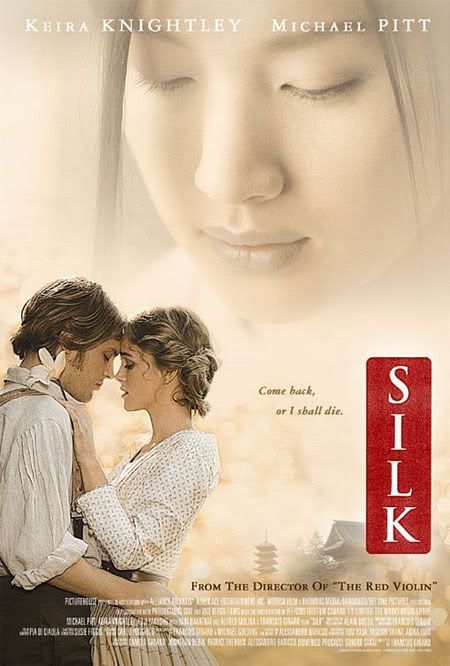
Of the many ways of representing love on the screen, three are currently in style. The raucous, humorous path of ribaldry is common enough, as is the vulgar and impatient voyeurism of pornography. Though the erotic may contain elements of both ribaldry and pornography, it tends to favor the slow glance rather than the mocking stare of ribaldry; it favors the lingering touch, not the interminable pounding of porn. The erotic is subtle and nuanced. A body is nude, not naked; to not know the difference is to not know when the erotic is present.
François Girard's film adaptation of Silk is an erotic film that revels in understatement. Visually alluring, it is a patient film filled with exquisite moments: the tea ceremony where Hervé first notices the concubine; Herve sitting by the window and watching Hélenè wander the garden with a lighted globe; the bathhouse scene is a delicate depiction of seduction.
Michael Pitt (brother of another famous Pitt) does a decent job as Hervé Joncour. Though it is a subtle performance, it isn't very detailed. Kiera Knightley is even-handed, and her potrayal of Hélenè is weighted toward the beginning and the end without much in the middle. A better Baldabilou could not have been found than Alfred Molina. The moment he appeared I nearly jumped from my seat to shout, "It's him!"
Though just over one hundred minutes long, Silk caresses each minute. Some reviews I've read complain that the film is slow, a criticism that makes me wonder if the book had been read or if the reviewer was just another contemporary victim of caffeinated carnality, unable to slow down and meander through this garden of a film. For such a speed freak, I wouldn't recommend Silk. Perhaps coarser viewers would prefer Burlap?
Friday, November 7, 2008
Thursday, November 6, 2008
A Slack, Boneless, Affected Word
Katherine Anne Porter preferred the term short novel over novella, which she called "a slack, boneless, affected word that we do not need to describe anything."
All four of them (Old Mortality; Noon Wine; Pale Horse, Pale Rider; The Leaning Tower) are collected with other works, including the oft-anthologized and masterful "The Jiliting of Granny Weatherall," in the lastest one-volume edition from Library of America.
More about her and this volume can be found here.
All four of them (Old Mortality; Noon Wine; Pale Horse, Pale Rider; The Leaning Tower) are collected with other works, including the oft-anthologized and masterful "The Jiliting of Granny Weatherall," in the lastest one-volume edition from Library of America.
More about her and this volume can be found here.
Tuesday, November 4, 2008
From A to X: A Story In Letters
John Berger's newest novella catches the eye of the New York Times.
"His most recent novel, 'From A to X: A Story in Letters,' plays with form in several ways: from the trompe l’oeil cover, which suggests the object in hand is not a work of fiction but an actual dossier, to the preface, in which someone named John Berger explains that he has come into possession of three packets of letters 'recuperated' from an abandoned prison. These missives were written by someone called A’ida ('if this is her real name') to her lover, 'known as Xavier,' jailed as a founding member of a 'terrorist network.' By telling us the letters are not in chronological order, by proposing that their contents may be written in code and by indicating places where the writing is illegible, Berger the author invites us to interact with, to co-create, the text, guessing at the meanings of words and phrases, pondering what might have happened in the interval between letters, and imagining the reasons some were never posted. But 'invites' is too mild a term, and 'co-create' too academic. What he really does is charge the reader with the responsibility to join in."
Though the reviewer calls it a novel, Berger's book weighs in at 197 pages.
"His most recent novel, 'From A to X: A Story in Letters,' plays with form in several ways: from the trompe l’oeil cover, which suggests the object in hand is not a work of fiction but an actual dossier, to the preface, in which someone named John Berger explains that he has come into possession of three packets of letters 'recuperated' from an abandoned prison. These missives were written by someone called A’ida ('if this is her real name') to her lover, 'known as Xavier,' jailed as a founding member of a 'terrorist network.' By telling us the letters are not in chronological order, by proposing that their contents may be written in code and by indicating places where the writing is illegible, Berger the author invites us to interact with, to co-create, the text, guessing at the meanings of words and phrases, pondering what might have happened in the interval between letters, and imagining the reasons some were never posted. But 'invites' is too mild a term, and 'co-create' too academic. What he really does is charge the reader with the responsibility to join in."
Though the reviewer calls it a novel, Berger's book weighs in at 197 pages.
Monday, November 3, 2008
Toni Morrison: a place out of no place
Lionel Shriver reviews Toni Morrison's new novella, A Mercy.
"A Nobel Prize winner, Toni Morrison is an American literary institution by now, and one can expect this short novel to draw plenty of admiration. For its originality, its bravery in tackling a time that's difficult to access, its egalitarian depiction of America's foundation on the unpaid labour of many different races, and its beautiful turns of phrase, it will have earned that admiration.
[...]
Sunday, November 2, 2008
A Debut of Distinction
Saleema Nawaz's Mother Superior is favorably reviewed. It includes short stories and a novella.
"But the subjects coalesce in the highly readable and involving novella, 'The Republic of Rose Island.' Here the woman narrator, named Georgia, tells the story of her late father, a rare stamp dealer, and her sister Lisa, who has disappeared somewhere in Europe.
Before leaving, Lisa was having an affair with handsome, rich Will, and is now pregnant. Will helps Georgia try to find Lisa, but slowly Georgia realizes that Will may not be as benign as he appears. Part mystery, part love story, it gains momentum without ever quite reaching its destination – which, in this case, more than satisfies."
A Slim Selection
A reflective review from The Hindu on a few classic selections.
"There are times when the mind hesitates to enter a substantial book, aware that it will not be able to do justice. [...] I look for the slimmest volumes, nothing more than a hundred or so pages, nothing that cannot be finished in one sitting. Surprisingly, there are many and the pile soon builds up. [...] So sometimes, four slim books can add up to more than four slim books. Or perhaps there are times when things simply resonate more."
Saturday, November 1, 2008
Villa des Roses
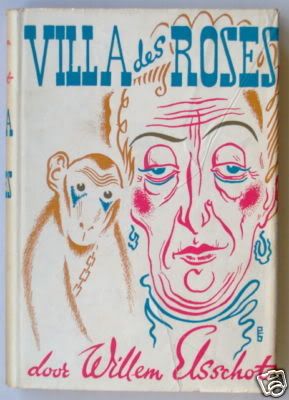 On my bookshelves, I have the entirety of Willem Elsschot's novellas translated into English. This impressive collection amasses three volumes: Cheese, Three Novels (a novella anthology containing Soft Soap, The Leg, and Will-'O-The-Wisp), and Villa des Roses. Had I more Flemish or Dutch litterateurs visiting my study, they would surely be impressed.
Villa des Roses is a character-driven novella with an episodic plot. To be accurate, it is populated by at least thirteen characters -- I may have miscounted, for it could be more -- and most of the episodes take place within the Villa des Roses, a pension in Paris. One of the major characters, Louise, is introduced in the shortest chapter of the novella: fifty-six words and then in the very next chapter she is hit on by all the men at the Villa des Roses. Eventually, she will fall in love with Richard Grünewald. This affair is effectively and sympathetically realized.
Madame Brulot, the Madame of Villa des Roses, appears in almost of every chapter. Like the pension itself, she acts as a gravitational force for the action in the novella, for all the happens is noted and noticed by her. She is married and owns a pet monkey, who will be murdered in an alternatively horrific and darkly comic episode. The murderer, Madame Gendron, the decrepit resident kleptomaniac who is brilliantly featured in a chapter entitled "The Oranges," will manage her revenge without getting caught. And the reaction of Madame Brulot, in just one or two phrases, shifts the horrific episode into a comic banality.
There are various ideas about novellas only consisting of one central character in a limited time frame and within a limited action. In its character density (there are more characters per square inch in this novella than in any other I can recall), Villa des Roses shows that theories are quaint distractions that no author nor reader should heed.
While reading Villa des Roses, I couldn't help but think of the British comedy, Fawlty Towers. This novella has a sitcom atmosphere similar to that classic Britcom, yet it lacks the histrionically loud John Cleese. Most of the humor in Villa des Roses is deadpan and subtle. Elsschot is essentially a realist with a wicked and whispering sense of humor.
 What's a director to do with a novella that reads thicker than its spine? The smart money would tell you to focus on a few characters in order to focus the narrative arc, even though other characters may minimized or left on the cutting room floor. By training the camera on Louise and Robert's tragic romance, the film version of Villa des Roses achieves a certain focus that novella may have lacked, but it ultimately suffers in substance and depth. Certain episodes seem out of place when interspersed with the love story. Madame Gendron's orange stealing scene feels unmoored and isn't funny, and her later revenge killing of Chico doesn't really make sense.
Director Frank Van Passel does an admirable with the melancholic atmosphere of the novella. In the film's centerpiece, we see the tragedy of abortion and how it effects Robert and Louisa as well as other residents of the Villa des Roses. Were the entire film handled as well as this harrowing episode, it would have been a superb film.
Unfortunately, most of the subtle elements of Ellschot's comedy of manners are lost in this adaptation. Some of the initial scenes of Robert and Louise falling in love are touching and show the tension and uncertainty during the first blush of new love. On the whole, the comic dimension is muted and ineffective. Not too say that Elsschot's novella is a laugh riot, but its humor, whether dark or sardonic or witty, is always under the surface of each scene. The film's ending is trite and to a certain degree predicable -- rather unlike the novella's.
The film is heavy in the appropriate moments and these are its strongest scenes. But it fails when dealing with the novella's elegant, sardonic touch and its rich assortment of characters and their interaction with each other in the Villa des Roses. Julie Delpy's portrayal of Louise is wonderful and her onscreen relationship and interaction with Shaun Dingwall as Richard Grünewald is nuanced and believable. Shirley Henderson's Ella, the cook, acts as our tour guide and is a good foil for Delpy. Though Aasgaard is a minor character in both the novella and the film, Erik Vercruyssen does an admirable of making him memorable and reminds a reader of the novella that its minor characters add depth and texture.
It is one thing to say that the book is better than the film, which in the case is certainly true. By extension, the film has given me a greater appreciation of the novella and Elsschot's deft style. When I first finished reading the novella, I wasn't sure if I wanted to return to it again. After seeing the film, I know that I must book a return visit to Villa des Roses.

Alembical from Golem Press
 A new anthology released today! From the website ...
"Our second book, "unofficially" releasing at the World Fantasy Convention 2008 on November 1st, is Alembical, an anthology that extends Paper Golem's commitment to the genre by focusing on the novella, an all too often, under-appreciated length. Alembical gives voice to four of the field's most dynamic writers at the powerful novella length, leaping from sub-genre to sub-genre, and leaving the reader breathless in the process. This anthology will redefine your understanding of the novella."
Redefine my understanding of the novella? Sounds exciting! This is the first volume in an annual anthology featuring four authors: Jay Lake, Bruce Taylor, James Van Pelt, and Ray Vukcevich.
Friday, October 31, 2008
The Man In The Picture: A Ghost Story by Susan Hill

A truly chilling tale, The Man In The Picture haunted me as I read it. A story within a story and yet within another story -- quite apropos, frame story for a story about painting -- the overall tale is about a painting of a Venetian carnival and the characters within it, one of whom makes eye contact with viewers. As we get deeper into the scene and eventually deeper into the dark history of the painting and its subjects, we become drawn into a dark world of dread.
The telling of such a tale is supposed to relieve the teller of the secret burden of such supernatural occurrences. Yet when a tale is passed on, the hearer bears the burden and can become consumed with the horrific, inexplicable details. One knows that the tale is true, but also knows that it must not be true. For were it true, the truth would be too terrifying. Paintings are not supposed to change, especially after the oil has been dry for decades. The old saw tells us that life imitates art. The Man In The Picture explores that notion and scares us with its implications of mortifying mimesis.
Wednesday, October 29, 2008
Here's a toast to 'Tiffany's' on landmark novel's 50th birthday
One of the books on my Lit Flicks Challenge list!
Myra Overton has sailed here from England on the Queen Mary 2 to celebrate her 70th birthday. First stop: Tiffany & Co. on Fifth Avenue.
Link.
Myra Overton has sailed here from England on the Queen Mary 2 to celebrate her 70th birthday. First stop: Tiffany & Co. on Fifth Avenue.
In her purse is an envelope addressed to "Mum." Inside is a homemade card sporting a photocopy of the iconic image of Audrey Hepburn with her long cigarette holder.
"You really can have breakfast at Tiffany's," reads the note from her son and daughter-in-law. It also says a gift card is waiting for her on the third floor.
"An American on the ship told me to forget about the movie and read the book," says Overton, who is from York, England. "He said it was the best thing Capote ever wrote. So I'm going out and finding it after I go in here."
That's impeccable timing on her part, because it's the 50th anniversary of Truman Capote's Breakfast at Tiffany's. A special edition (Vintage, $12.95, paperback) of the novella is being released in November, packaged with three other Capote classics, including A Christmas Memory.
Link.
Monday, October 27, 2008
Bookslut October Roundup
In the past Bookslut had a novella review series, Small, But Perfectly Formed. While that series no longer runs, they still frequently review novellas. Each month I'll offer a roundup of their offerings.
Hail The Three Marys, a review of three novellas by Marie Darrieussecq, Marie-Claire Blais, and Marie Ndiaye.
"A trio of Maries, writing in their French mother tongue, have emerged on the literary scene, and have proved that they can break out of the gender mould, whilst remaining defiantly feminine. These talented women have relaunched the French novel on the international stage, and are forcing the critics to retract their draconian judgments."
A History of the World for Rebels and Somnambulists by Jesus del Campo
"Enter the Spanish philologist Jesus del Campo and his slim, crazy, funny, History of the World for Rebels and Somnambulists, which is exactly what it says it is. It’s a roughly -- very roughly -- chronological account of world history, marked by the bravado and befuddlement of presidents, biblical figures, scientists, poets, magicians and God alike."The Bruise by Magdalena Zurawski
"Had I not completed Magdalena Zurawski’s prize-winning novel, The Bruise, with my fingers gripping the cover and its pages pressed beneath my thumbs, I might have questioned whether my astonishing literary odyssey was instead some feverish dream."Hail The Three Marys, a review of three novellas by Marie Darrieussecq, Marie-Claire Blais, and Marie Ndiaye.
"A trio of Maries, writing in their French mother tongue, have emerged on the literary scene, and have proved that they can break out of the gender mould, whilst remaining defiantly feminine. These talented women have relaunched the French novel on the international stage, and are forcing the critics to retract their draconian judgments."
Friday, October 24, 2008
A Golden Jubilee For "Things Fall Apart"
A birthday party for an African classic.
"Chinua Achebe's 'Things Fall Apart', which celebrates its golden jubilee this year, is Africa’s best known work of literature. The slim novel has been translated into 50 languages and has sold 10m copies. Never once has it been out of print."
From the Economist.
"Chinua Achebe's 'Things Fall Apart', which celebrates its golden jubilee this year, is Africa’s best known work of literature. The slim novel has been translated into 50 languages and has sold 10m copies. Never once has it been out of print."
From the Economist.
Saturday, October 18, 2008
The Day of the Owl by Leonardo Sciascia
 In the post-Godfather cinematic imagination, the Mafia have always existed. Dons and their families have big weddings and ghastly shootouts in the booths of Italian restaurants. But after reading Leonardo Sciascia's The Day of the Owl, one realizes the Sicilian crime syndicate was once considered a myth, a legend born out of the aftermath of Fascist Italy.
The novella's story is simple enough: a man is murdered on a bus and the crime is eventually solved by Captain Bellodi, an Italian from Parma but considered a foreigner by Sicilian standards. One of the Carabineri informants leaves a letter after his death (another murder) which links all the crime in the city to Don Mariano Arena, the local family boss. Though the case eventually goes to a high court in Rome, nobody is punished.
Written in 1961, it is difficult for us on the other side of the Godfather to imagine how dangerous it would have been for a writer, even one of fiction, to write anything about the mafia. Yet the coda tells otherwise: "One thing is certain, however: I was unable to write it with that complete freedom to which every writer is entitled." He further mentions that the reader shouldn't confuse the characters in his story with any "real person or actual occurrence." We see this caveat at the end of films or one of the front pages of other works of fiction as part of the required legalese, but to have the author pen a special coda (and thereby stepping out from behind the invisible narrator's curtain) makes one wonder what kind of peril Sciascia had entered by writing The Day of the Owl.
Friday, October 17, 2008
Untrue Confessions
Review of The Partisan's Daughter by Louis de Bernières:
"Two unreliable narrators perform a discordant but appealing duet in A Partisan's Daughter, a new short novel by Louis de Bernières, author of Birds Without Wings. One of them, Roza, a native of the former Yugoslavia, has long been missing; the other, Chris, a mopey old Englishman, reciting his story 30 years after the fact, comes under the heading of 'not dead yet.' He's had one great adventure in his life, and he tells the reader about it in the mopiest of tones. Life has more than passed him by. You might say that life has lapped him many times in the boring marathon of existence. But yes, just once, for a limited time, he fell under the thrall of a modern Scheherazade who (to quote the Beatles) 'filled his head with notions, seemingly."'The storyteller was Roza, and as he listened to her, his excruciatingly dull life was redeemed by the enchantment of narrative -- and the thought of future sex."
"Two unreliable narrators perform a discordant but appealing duet in A Partisan's Daughter, a new short novel by Louis de Bernières, author of Birds Without Wings. One of them, Roza, a native of the former Yugoslavia, has long been missing; the other, Chris, a mopey old Englishman, reciting his story 30 years after the fact, comes under the heading of 'not dead yet.' He's had one great adventure in his life, and he tells the reader about it in the mopiest of tones. Life has more than passed him by. You might say that life has lapped him many times in the boring marathon of existence. But yes, just once, for a limited time, he fell under the thrall of a modern Scheherazade who (to quote the Beatles) 'filled his head with notions, seemingly."'The storyteller was Roza, and as he listened to her, his excruciatingly dull life was redeemed by the enchantment of narrative -- and the thought of future sex."
Tuesday, October 14, 2008
Amazon to Sell E-Lit Shorts for 49 Cents a Piece
Novelini?
"If it works for iTunes… Online retailer Amazon.com is offering digital-only bits of literature - Amazon Shorts - for 49 cents each, including samples from new authors, alternate chapters and scenes to well-known stories, one-act plays, classic short stories and memoirs from writers, reports Information week. Buyers can read the works or print them from the Amazon site, download them as PDF files or request that they be emailed as plain text.
Novelini.
"If it works for iTunes… Online retailer Amazon.com is offering digital-only bits of literature - Amazon Shorts - for 49 cents each, including samples from new authors, alternate chapters and scenes to well-known stories, one-act plays, classic short stories and memoirs from writers, reports Information week. Buyers can read the works or print them from the Amazon site, download them as PDF files or request that they be emailed as plain text.
Steve Kessel, Amazon.com's VP of digital media, is quoted by Reuters as saying, "We hope that by making short-form literature widely and easily available, Amazon.com can help to fuel a revival of this kind of work."
Publishers have always had a hard time selling and marketing the single, short-form work - the novella, or the novelette, or the even shorter "novelini" - he said."
Novelini.
Subscribe to:
Posts (Atom)


 Posts
Posts

